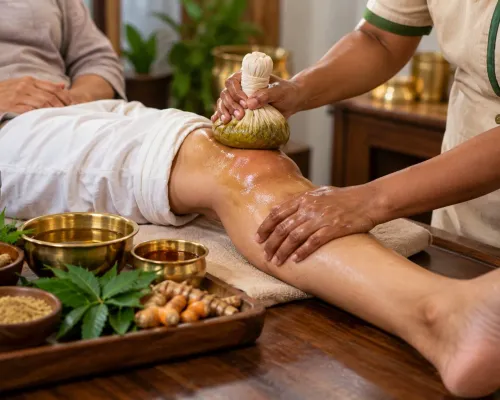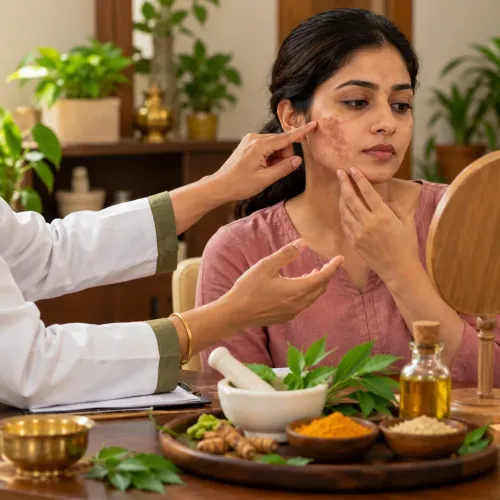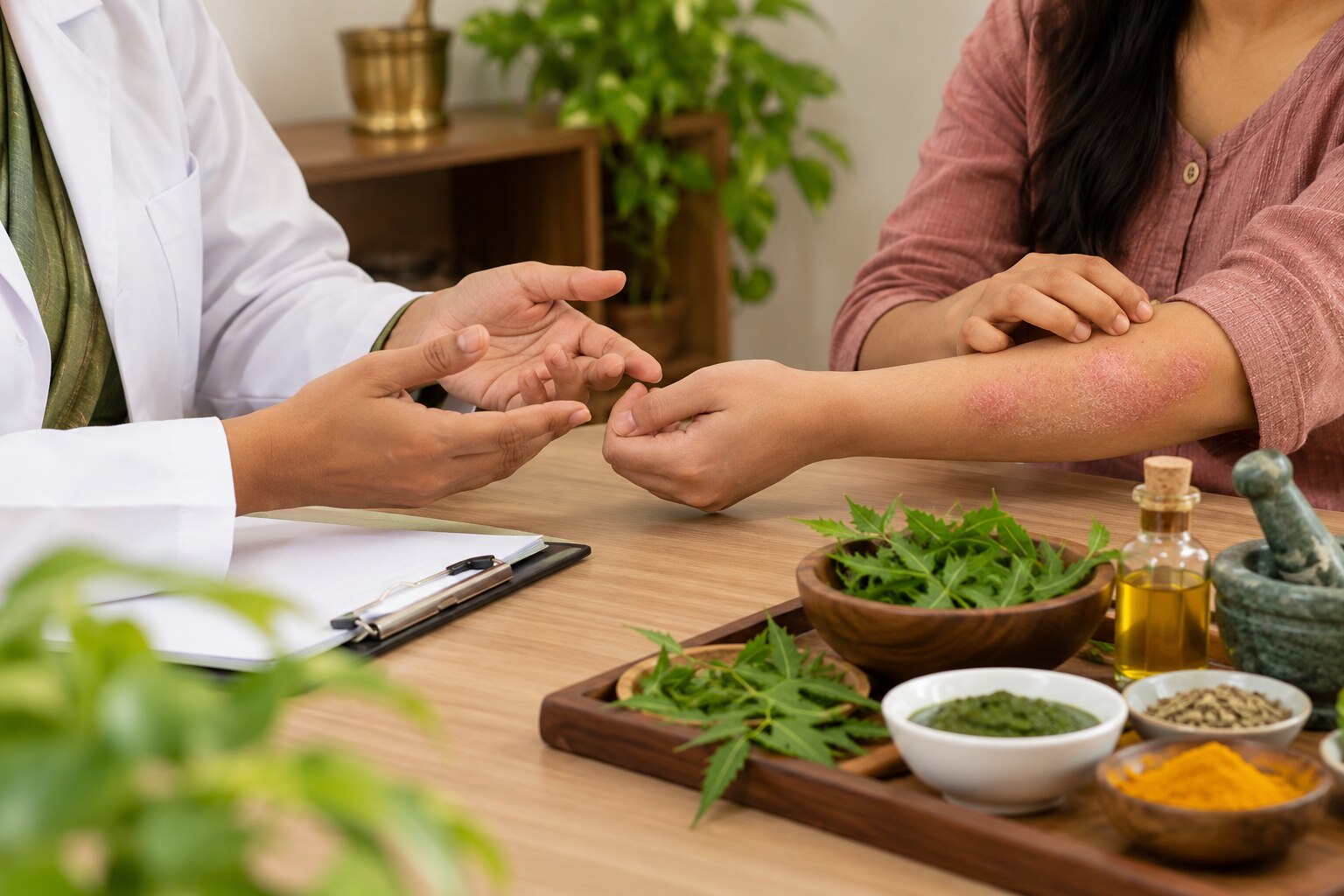
Itchy, dry or inflamed skin is not always eczema, and a natural ingredient is not automatically safe for a damaged skin barrier. You will learn how to recognise common eczema patterns, build a protective daily routine, assess Ayurvedic products safely, and combine complementary care with appropriate medical treatment.
Key takeaways
- Confirm whether symptoms indicate eczema, contact dermatitis, or another condition.
- Use fragrance-free products and short lukewarm baths to protect the skin barrier.
- Patch-test Ayurvedic oils and herbs before applying them to eczema-prone skin.
- Keep Ayurvedic care complementary to prescribed eczema treatment and medical review.
Is it eczema, contact dermatitis, or another skin condition?
Atopic dermatitis is a recurring inflammatory condition linked to a weakened skin barrier. Eczema symptoms include intense itching, dry or scaly patches, redness, cracks, oozing, and thickened skin from scratching. It commonly affects the face, hands, elbow and knee folds, and neck. Sensitive skin describes a feeling, not a diagnosis.
- Contact dermatitis begins where an irritant or allergen touched you, such as soap, fragrance, detergent, nickel, or cosmetics. It often improves after avoiding that exposure, though allergic reactions can spread beyond the contact area.
- Seborrheic dermatitis causes greasy white or yellow scale on the scalp, eyebrows, sides of the nose, ears, or chest.
- Psoriasis produces sharply defined, thicker plaques with silvery scale, often on the elbows, knees, scalp, or lower back.
- A fungal infection often forms an expanding ring with a clearer centre and a scaly edge. Steroid creams can disguise or worsen it.
- Hives are raised, smooth welts that move or fade within 24 hours rather than remaining in one patch.
- Scabies causes severe night-time itching, tiny bumps, or burrows between the fingers, at the wrists, waist, or genitals, often affecting household contacts.
Pain, warmth, pus, yellow crusts, fever, or painful clustered blisters needs prompt medical assessment. A clinician should confirm the cause before you start an Ayurvedic regimen or repeatedly test new products.
Which triggers and daily habits protect the skin barrier?
Protecting the skin barrier starts with removing avoidable irritation, not with harsh scrubbing. Eczema triggers include soaps, detergents, fragrances, wool, sweat, heat, dust, nickel, cosmetics, stress, and a food that causes a reproducible immediate allergic reaction.
| Exposure | What goes wrong | Safer change |
|---|---|---|
| Soap or detergent | Strips oils and stings cracks | Use a gentle, fragrance-free cleanser and fragrance-free laundry detergent |
| Perfume or cosmetics | Fragrance and preservatives can cause contact dermatitis | Choose products labelled fragrance-free, not merely unscented |
| Wool, rough seams, or tight clothes | Friction worsens itching and redness | Wear soft, loose cotton and remove irritating labels |
| Heat, sweat, or dust | Traps moisture and increases itching | Keep the room cool, rinse sweat, and reduce dusty contact |
| Nickel jewellery | Direct contact can produce a recurring rash | Avoid nickel or cover the contacting surface |
- Bathe in lukewarm water for 5–10 minutes. Longer, hot showers dry sensitive skin.
- Clean only sweaty or dirty areas; do not scrub, exfoliate, or use a loofah.
- Pat dry while the skin remains slightly damp, then apply a thick fragrance-free moisturiser within three minutes. Creams and ointments protect better than lotions.
- Reapply after handwashing and whenever dryness returns. Change out of sweaty clothing promptly.
How can you use Ayurvedic oils, herbs, and home remedies safely?
“Natural” does not mean eczema-safe: Ayurvedic oils for eczema, herbal creams, and natural eczema remedies can irritate skin or trigger allergic contact dermatitis. Avoid lemon juice, vinegar, baking soda, toothpaste, undiluted essential oils, and abrasive scrubs; they can burn the barrier and intensify itching. Never apply essential oils to broken or actively inflamed skin.
- Choose one clearly labelled product without fragrance, and introduce only one change at a time.
- Perform a patch test on intact skin, such as the inner forearm, using a small amount once daily for two days. Do not test an untried product on an eczema patch.
- Stop immediately for burning, swelling, hives, blisters, increased redness, or a spreading rash. Wash it off gently and seek medical advice if the reaction persists.
- Discuss oral Ayurvedic herbs before taking them. The consultation must cover medicines, supplements, pregnancy or breastfeeding, allergies, and liver or kidney disease because herbal products can interact with drugs or cause organ injury.
- Reject “detox,” purging, or internal cleansing claims; they can delay diagnosis and treatment.
| Product or approach | Safer decision | Main concern |
|---|---|---|
| Ayurvedic oil or herbal cream | Patch test and use one product | Irritant or allergic dermatitis |
| Essential oils | Avoid on eczema or broken skin | Concentrated oils can burn |
| Oral Ayurvedic herb | Obtain clinician guidance first | Drug interactions or liver, kidney, or stomach injury |
| Home remedy | Keep using bland moisturiser and prescribed treatment | Replacement can allow infection or flares to worsen |
Rapid worsening, pain, warmth, pus, crusting, fever, or painful clustered blisters needs prompt medical assessment. Painful blisters can signal eczema herpeticum, which requires urgent care.
What should an Ayurvedic eczema assessment cover?
Before recommending treatment, a responsible practitioner must confirm the eczema diagnosis rather than treat every itchy rash as “sensitive skin.” An eczema assessment should record when the rash began, its locations, flare pattern, possible exposures, allergies, pregnancy or breastfeeding, and any liver or kidney disease.
The practitioner should examine the skin for dryness, scale, redness, cracks, oozing, thickening, crusts, and the distribution of lesions. Review every medicine, supplement, and cosmetic, including oral Ayurvedic products: herbs can interact with prescriptions or injure the liver, kidneys, or digestive system.
An Ayurvedic eczema consultation at AyurBless Clinic should apply this same safety check before suggesting an oral remedy.
| Finding | What it may signal | Action |
|---|---|---|
| Rapidly worsening rash, warmth, swelling, increasing pain, pus, or yellow crusts | Eczema infection, often bacterial | Arrange prompt medical assessment |
| Fever with a spreading or painful rash | More serious infection | Seek prompt medical care |
| Clusters of small, painful blisters or punched-out sores | Possible eczema herpeticum, a viral emergency | Get urgent medical assessment; do not rely on home remedies |
| Scaly ring-shaped patches, burrows, or widespread nighttime itching | Fungal infection or scabies rather than eczema | Obtain a clinical diagnosis before treatment |
Stop any new product that causes burning, swelling, or worsening. Do not use detox, purging, or internal cleansing to delay an examination.
How should Ayurvedic care fit with proven eczema treatment?
Use proven eczema treatment to control inflammation and repair the skin barrier; add Ayurvedic care only after the diagnosis and treatment plan are clear. No good-quality evidence shows that Ayurvedic herbs or procedures cure atopic dermatitis, and inconsistent preparations make safety difficult to judge.
| Option | Main role | Important limitation |
|---|---|---|
| Moisturisers | Replace lost barrier oils and reduce dryness | Use a bland, fragrance-free cream or ointment often, especially after bathing; lotions protect less |
| Topical corticosteroids | Calm an active eczema flare | Correct potency, amount, body site, and duration matter; undertreatment can prolong inflammation |
| Calcineurin inhibitors | Reduce inflammation without a steroid, often on the face, eyelids, or skin folds | They can sting initially and require clinical guidance |
| Antihistamines | Help selected allergy symptoms or nighttime itch | They do not repair the barrier or treat eczema inflammation; sedating types can impair alertness |
| Ayurvedic approaches | Offer personalised lifestyle or topical support | Evidence is limited, and “detox” or purging is not established eczema treatment |
Complementary Ayurvedic care is safer than replacement treatment when you continue prescribed creams and regular moisturising, choose one clearly labelled, quality-controlled product, and introduce one change at a time. Stop it if burning, swelling, or a worsening rash develops.
Do not apply unreviewed oils or occlusive mixtures over a severe flare, infected skin, or prescribed medicine without asking a clinician. Seek medical review if treatment fails, because infection or another skin condition can resemble eczema.
Frequently asked questions
How can you tell eczema from contact dermatitis or another skin condition?
Eczema often causes recurring itch, dryness, redness, scaling, cracks, or thickened skin. Contact dermatitis follows exposure to an irritant or allergen and needs trigger tracing. A clinician should assess spreading rashes, infection signs, or uncertain diagnoses.
Which daily habits help protect the skin barrier?
Use fragrance-free cleansers and moisturisers, take short lukewarm baths or showers, pat skin dry, and moisturise while it is still damp. Avoid scratching, harsh scrubs, wool against the skin, and new products during a flare.
How can you use Ayurvedic oils, herbs, and home remedies safely?
Check every ingredient, patch-test on a small area for 24 to 48 hours, and stop if burning, swelling, or worsening redness occurs. Do not apply unverified mixtures to broken or infected skin, and avoid replacing prescribed treatment.
What should an Ayurvedic eczema assessment cover?
It should review the rash pattern, itching, duration, triggers, medicines, allergies, diet, sleep, stress, digestion, past treatments, and signs of infection. The practitioner should also inspect the skin and identify when medical referral is needed.
How should Ayurvedic care fit with proven eczema treatment?
Use Ayurvedic lifestyle guidance or topical products only after checking their ingredients and compatibility with your treatment plan. Continue prescribed moisturisers or medicines, and seek medical care for pain, pus, fever, rapid spreading, or eye involvement.